
Hardscaping Choices for Better Runoff Management
Hardscaping gets talked about as if it is mainly about looks, but on a property with grading, slope, and summer water limits, it is really about control. Concrete, stone, decomposed granite, retaining edges, steps, drains, and planted swales all shape where water goes when the rain finally arrives. In the San Gabriel Valley, where hillside landscaping and water-wise design often meet on the same parcel, that choice matters more than most homeowners expect.
A yard that sheds water too quickly can send runoff toward the street, the foundation, or a neighbor’s property. A yard that holds water in the wrong place can leave muddy patches, erosion scars, and stressed planting beds. The best hardscaping choices do not fight the site, they work with it. They slow water just enough to let the soil absorb what it can, direct excess where it will not cause damage, and create a landscape that still looks intentional in dry weather, not only during a storm.
Runoff is a design issue, not just a drainage problem
People often call a drainage contractor after they notice a pooling area or a muddy strip along a walkway. By then, the site is already telling them that the original layout did not respect how water moves. Hardscaping is one of the strongest tools for correcting that, because hard surfaces either create runoff or redirect it. A patio edge, a driveway pitch, a retaining wall, or the spacing between pavers can change how quickly water leaves a property.
That is why runoff management should be part of landscape design from the start, especially in areas with slopes. A hillside in the San Gabriel Valley does not behave like a level lot in a flat subdivision. Water gains speed on a grade, picks up soil, and tends to follow the same path every time it rains. If the hardscape is arranged without that in mind, erosion shows up sooner than people expect, often along corners, transitions, and the downslope edge of paved areas.
Good runoff planning starts with the basics that California water guidance emphasizes: irrigation, soil, sun exposure, and plant selection all matter before turf is removed or a yard is redesigned. Those same factors matter when hardscape is added. A dry, compacted soil will absorb less. A hot, exposed slope will need different treatment than a shaded corner. A plant palette built for the wrong conditions can fail, and when that happens the hardscape ends up carrying more runoff than it should.
Permeable surfaces earn their keep
Permeable hardscaping is one of the most practical ways to reduce runoff without giving up usable space. It does not make a site magically absorb every drop, but it slows water and gives it a path into the ground instead of straight into the gutter. For many residential projects, that is enough to make a noticeable difference.
Permeable pavers are often the first choice people consider. They work well on walkways, patios, and some light-use drive areas when they are installed with the right base and maintained so joints do not clog with sediment. The material itself matters less than the system underneath it. If the base is too tight or the site was not graded correctly, the pavers may look permeable while performing like a sealed surface.
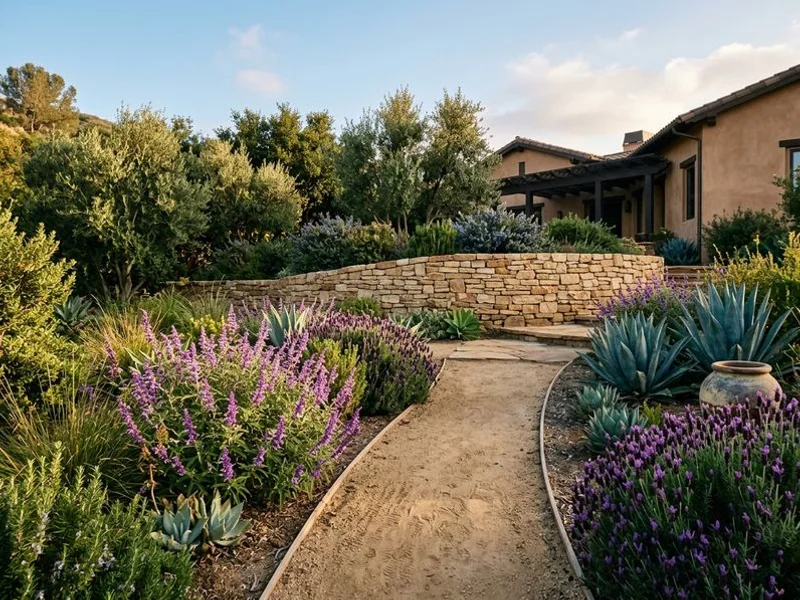
Decomposed granite is another useful option, particularly on paths or informal gathering areas. It feels softer underfoot and visually suits drought resistant landscaping, especially when paired with native plants. It does have limits. On steep grades or in areas where stormwater concentrates, loose aggregate can wash out if it is not contained properly. On a hillside, that means edging and drainage planning are not optional. They are the difference between a stable surface and a maintenance headache.
Gravel can also help, especially in narrow side yards, planting buffers, or around downspout dispersion areas. Used thoughtfully, it breaks up splash, reduces mud, and gives excess water a place to spread. But gravel is not a universal fix. If it is dumped over compacted soil with no outlet, water still runs off it. If it is placed beside a wall with no drain path, it can trap moisture where you do not want it. Good hardscaping is less about material alone and more about how each element handles water in sequence.
Slopes need structure, not just surface treatment
Hillside landscaping in the San Gabriel Valley often calls for a mix of hardscape and planting that stabilizes the site without making it feel overbuilt. On a slope, the goal is not to flatten everything. The goal is to interrupt the speed of water and keep soil in place.
landscaping companies in Los AngelesRetaining walls can be essential when the grade is too sharp for safe planting or maintenance. They create usable terraces, break long slopes into smaller sections, and give stormwater somewhere to slow down. A well-placed wall can also protect planting areas from being washed out during heavy rain. But walls should never be treated as decoration first and engineering second. Drainage behind the wall matters, and so does the way the wall ties into nearby surfaces.
Terracing is often a stronger answer than one tall wall. Several shorter levels can manage runoff more gracefully, especially when each level includes planting beds that absorb water and help anchor the soil. On a hillside property, that pattern can look natural if the materials are chosen carefully. Stone steps, low seat walls, and planted buffers can turn a steep, difficult area into a layered landscape that handles water better than a broad open slope ever could.
There is also a practical maintenance angle. Steep grades are hard to mow and harder to irrigate evenly. When hardscaping replaces problematic turf, the landscape usually becomes easier to manage and more water-efficient. That matters in a region where state rules for water-efficient landscapes are already influencing how new and renovated yards are planned. If the hardscape helps reduce the amount of irrigated area while improving runoff control, it is doing double duty.
The edges are where runoff problems usually show up
Most drainage failures are not dramatic. They happen at transitions. Where the patio meets a bed. Where the driveway meets the swale. Where the path drops toward the side yard. Where hard surface ends and bare soil begins.
That is why edge treatment deserves more attention than it usually gets. A clean border can keep mulch from washing out and help water move where it is meant to go. Low curbs, gravel trenches, and planted strips can soften the meeting point between hardscape and softscape so runoff is absorbed rather than concentrated.
This is also where the mistake of over-paving becomes clear. A yard with too much impermeable surface sends water racing to the lowest point. A better design keeps some room for infiltration and spreads flow across several surfaces instead of one. In practice, that may mean shrinking a patio by a few feet to preserve a planting strip, or replacing a solid walkway with individual pavers set in a permeable base. Small changes can make a big difference when the rain comes in a short burst.
On properties with visible hillside character, that balance matters aesthetically too. The San Gabriel Valley has a landscape identity that is shaped by slope, open sky, and dry-season plant structure. Hardscaping that respects those conditions tends to look more settled and less forced. It feels like it belongs to the site instead of sitting on top of it.
Water-wise planting and hardscape should be designed together
Hardscaping alone cannot solve runoff if the planting plan is weak. California water guidance points homeowners toward evaluating sun exposure, soil, irrigation, and plant needs before changing the landscape. That advice applies even more when hardscape is involved, because the plants around it help determine whether water is absorbed or shed.
A drought-tolerant planting scheme does more than conserve water. It can stabilize slopes, reduce bare soil, and slow runoff near hard edges. California native plants and other climate-appropriate species are especially useful for this. On local properties, plants such as California buckwheat, California sagebrush, manzanita, ceanothus, monkeyflower, foothill penstemon, bunchgrasses, and San Gabriel oak can fit into a design that needs both erosion control and visual restraint.
These plants are not just decorative. They serve different site functions. Bunchgrasses can help hold soil. Shrubby natives can create a rougher surface that slows water. Plants adapted to sun and dry conditions are better suited to the hot, exposed parts of a slope where irrigation water runs off before it sinks in. That matters in the San Gabriel Valley, where microclimates can change quickly from a shaded side yard to a hot south-facing bank.
A practical point often gets missed here. If the planting plan needs heavy irrigation to survive, the hardscape may end up working against itself. Water can pool behind retaining edges, flood narrow strips, or move across a path too quickly. A design rooted in drought resistant landscaping tends to be more stable over time because the plants and the hardscape are designed for the same climate reality.
Firewise thinking belongs in runoff planning too
In foothill and hillside areas, runoff management and firewise planning should not be treated as separate conversations. They affect the same terrain. The same slope that pushes stormwater downhill can also carry heat and dry fuels during fire season. The same planting zone that needs to hold soil may also need to support defensible-space goals.
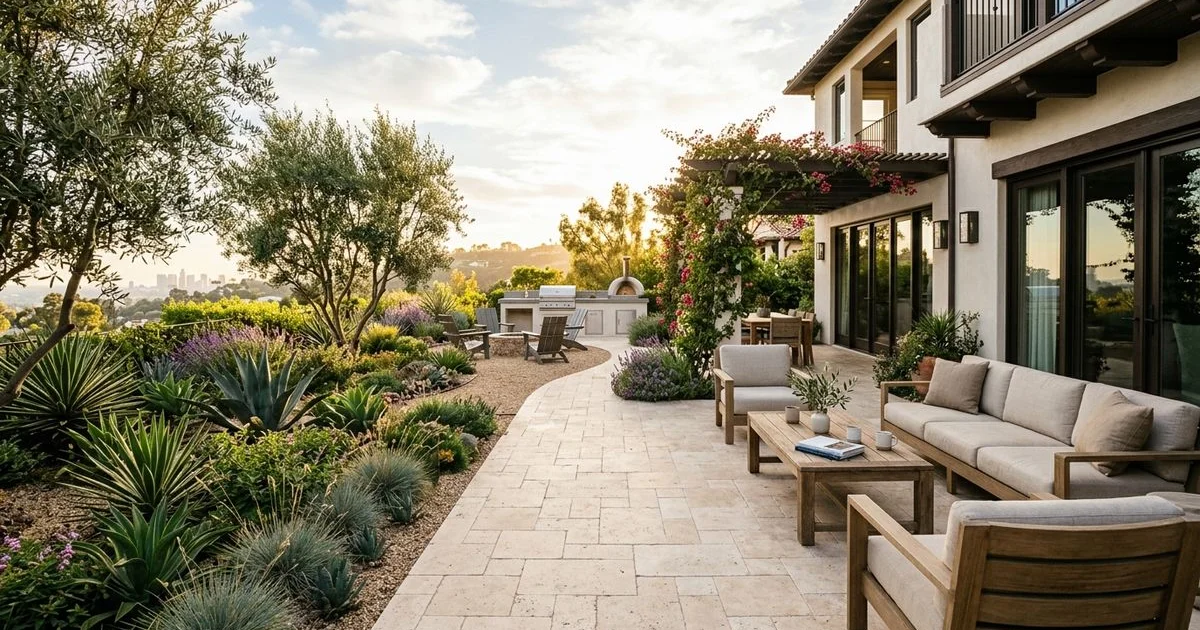
That does not mean a property has to feel bare or stripped down. It means materials and plants need to be selected with judgment. Hard surfaces near the house can help define safer zones, while lower-growing native planting farther out can support the broader landscape without crowding structures. Rock mulch, stone borders, and carefully spaced plant groupings can help keep the design organized while reducing areas where debris collects.
The California Native Plant Society’s local guidance on fire-resistant planting and ember-resistant zone rules reflects a reality many homeowners already know from experience. In hillside neighborhoods, what survives dry weather and what manages stormwater are often the same plants. A landscape that dries out cleanly, does not shed soil, and keeps combustible material away from the immediate perimeter can support both runoff control and firewise goals.
That said, there is no single plant palette that solves every property. A shaded north slope, a hot open bank, and a narrow entry court will not need the same solution. The better approach is to use hardscape to shape the water path first, then fit planting to the microclimate around it.
Turf removal makes sense when the replacement is designed honestly
Turf removal comes up often in California, and for good reason. Lawns on sloped or sun-baked sites can demand more water than they are worth, especially when the space is awkward to mow or prone to runoff. But taking out turf is not the final step. It is the beginning of a design problem that needs to be solved carefully.
The California landscape guidance encourages homeowners to look at soil, irrigation, exposure, and plant selection before removing grass. That is sound advice because once turf is gone, the site reveals its true behavior. Water may rush through compacted areas, collect near a foundation, or expose erosion channels that the lawn had been hiding. Hardscaping can help redefine those zones, but only when it is paired with a realistic planting and irrigation retrofit.
This is also where local regulations matter. California’s Model Water Efficient Landscape Ordinance has pushed new and renovated landscapes toward more efficient water use, native or climate-appropriate plants, and alternative water sources when available. For a homeowner, that often translates into a landscape that relies less on broad irrigated turf and more on a combination of hardscape, planting beds, and targeted irrigation. The benefit is not only lower water use. It is a site that makes more sense during storms, because there is less flat, shallow-rooted turf contributing little to runoff control.
HOA rules can complicate the process, but they do not erase it
Homeowners’ association rules can make people nervous about changing a front yard, especially when the project includes drought-tolerant landscaping, native plants, or turf replacement. In California, homeowners’ associations cannot prohibit certain water-efficient landscaping choices during drought-related restrictions. That does not mean every project gets a free pass, because design standards and approvals may still apply. It does mean a homeowner should not assume that an HOA can block a reasonable water-saving landscape outright.
That is relevant to runoff management because the best drainage solution often involves visible changes. A permeable path, a planting strip, a retaining edge, or a terraced slope may be exactly what the site needs, even if the old lawn had a cleaner uniform look. When an association is involved, it helps to frame the project around function, maintenance, and visual quality rather than only water savings. A well-organized hardscape plan can look more polished than a patchy lawn ever did, especially on a property with grade changes.
The best runoff solutions look intentional in every season
A good hardscape should not only work in a storm. It should look composed in August, when the yard is dry and the light is harsh. That is where many projects rise or fall. If the solution to runoff depends on visible pipes, awkward berms, or surfaces that seem temporary, the landscape may function but still feel unresolved.
The stronger projects tend to share a few traits. They use grade changes to guide water instead of fighting them. They mix permeable and impermeable materials with care. They keep water away from vulnerable edges. They pair hardscape with plants that can handle local conditions. They respect the hillside character of the San Gabriel Valley rather than trying to erase it. And they leave room for maintenance, because even the best drainage system needs occasional attention.
A few details can decide whether the system holds up over time. Joints in permeable pavers need to stay open enough to function. Gravel and decomposed granite need containment at their edges. Retaining walls need drainage behind them. Plant beds need irrigation that matches the soil and exposure. None of this is glamorous, but all of it matters. The difference between a landscape that quietly manages runoff and one that becomes a recurring repair project usually comes down to these unglamorous choices.
When hardscaping is done well, it gives stormwater a clear path and the property a stronger sense of order. It supports erosion control on slopes, reduces wasted irrigation, and helps a landscape fit the climate rather than resist it. In a region where water conservation, hillside conditions, and firewise planting all matter at once, that kind of design is not a luxury. It is the most practical way to build a yard that holds together year after year.