
Hillside Planting Ideas for Soil Stability and Water Savings
A hillside can be one of the most rewarding places to garden, but it is also one of the most demanding. Soil moves faster on a slope. Water behaves differently. Sun exposure changes from the top of the grade to the bottom, sometimes dramatically over just a few feet. In the San Gabriel Valley and other foothill communities, those realities are not abstract. They shape how a landscape performs through hot afternoons, dry spells, heavy seasonal rains, and the ever-present need to keep runoff where it belongs.
The best hillside landscaping does two jobs at once. It holds soil in place, and it uses water wisely. That pairing matters more now than ever, especially in California, where water-efficient landscapes, native plants, and climate-appropriate design are not just good ideas, they are the direction the state has been pushing for years. For a sloped property, the goal is not to fight the site. It is to work with the slope, the soil, and the microclimates already there.
A well-planned hillside planting scheme can reduce erosion, improve stormwater absorption, lower irrigation demand, and create a landscape that feels like it belongs to the terrain instead of sitting on top of it. When the planting is paired with thoughtful hardscaping, the results are even stronger. Retaining elements, terraces, pathways, and drainage details can support the planting while making maintenance more realistic. Good landscape design is rarely about one feature. On a hill, the entire system has to cooperate.
Start with the slope, not with the plant list
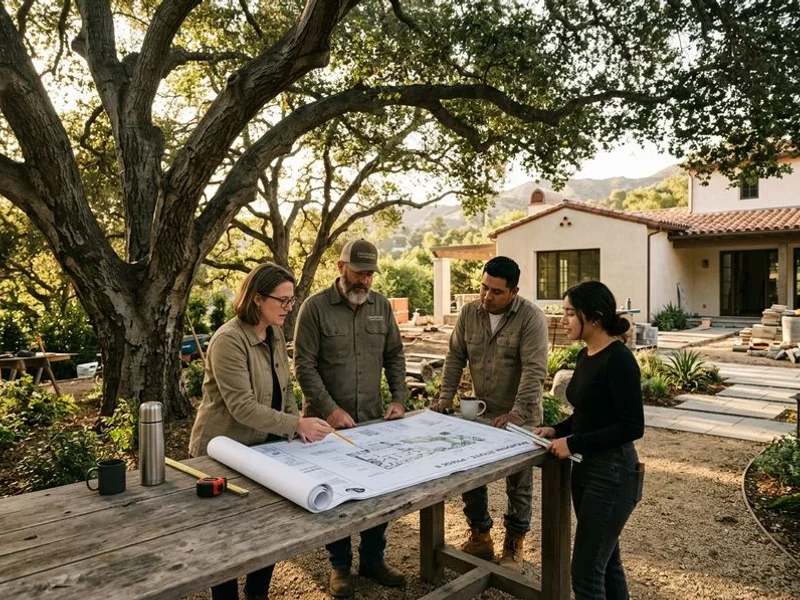
The biggest mistake I see on hillside properties is choosing plants before understanding the site. That usually leads to disappointment. A plant that looks perfect in a nursery can struggle on an exposed west-facing slope, or it may spread too slowly to stabilize loose soil where a fast root system is needed. Before anyone starts pulling turf or ordering shrubs, it pays to study the hillside in practical terms.
Sun exposure comes first. Parts of the slope may bake all afternoon, while a lower section sits in partial shade or gathers cold air. Soil is next. Some hillsides drain quickly and dry out within hours after irrigation, while others shed water so fast that even drought tolerant landscaping needs help getting established. Irrigation matters too. A slope that has been watered with spray heads for years may have shallow rooting and compacted patches, which changes how new plants should be introduced. California water guidance is clear on this basic point: assess irrigation, soil, sun exposure, and plant selection before removing turf or redesigning the landscape. That sequence saves money and prevents a lot of avoidable failure.
Microclimate is the fourth piece. On a single hillside, you may have a hot upper face, a slightly cooler north-facing section, and a wind corridor that dries everything out faster than expected. Once you start reading a slope this way, plant placement becomes much more deliberate. You stop asking, “What grows on hillsides?” and begin asking, “What grows on this hillside, in this exposure, with this drainage pattern?”
Plants that help hold soil and use less water
For soil stability, the best plants are usually the ones that build a strong root network without demanding constant water or feeding. California native plants are especially useful here because many are adapted to local conditions and can handle dry summers once established. In the San Gabriel Valley, that makes a lot of sense both ecologically and practically.
Some of the most reliable hillside performers are shrubs and perennials that root deeply, knit the soil surface together, and tolerate reflected heat. California buckwheat is one example. It is lean, tough, and useful on sunny slopes where a full, lush look would be a mistake. California sagebrush handles dry conditions well and can be a graceful part of a larger plant matrix. Manzanita and ceanothus bring structure, and both can be valuable in a water-wise hillside design when matched carefully to soil and exposure. Monkeyflower and foothill penstemon add color without asking for a high irrigation schedule, while bunchgrasses help cover ground, slow runoff, and soften the edges between shrubs. San Gabriel oak is another locally named native species that connects the landscape to its regional identity.
It is tempting to think of stability as a function of roots alone, but canopy and spacing matter too. On a slope, a mixed planting usually performs better than a monoculture. A single shrub type can look tidy at installation, but mixed layers of shrubs, perennials, and grasses tend to intercept more rainfall, slow sheet flow, and create more resilient soil coverage across the year.
The right plant is not only drought resistant landscaping material. It is a plant that fits the job. A broad shrub may be excellent for anchoring a terrace edge but too heavy visually for a narrow swale. A low groundcover may suppress erosion beautifully on a mild slope but need help on a steeper bank where water moves too quickly for shallow roots to get established. That is why hillside landscaping works best when each zone has a purpose.
A practical way to think about plant choice
If you are narrowing the field, start with plants that share these traits:
That short filter does more than reduce irrigation demand. It also makes maintenance more manageable over time. A hillside planted with the right structure is less likely to need constant replanting after hot weather, and it tends to recover better after storm events.
Water savings begin below the mulch
People often talk about water savings as if they are only a matter of choosing drought tolerant landscaping plants. Plant choice matters, but the irrigation system matters just as much, sometimes more. California landscape guidance emphasizes efficient irrigation because a well-chosen plant can still waste water if the delivery system is poor.
On slopes, overhead spray can be a problem. Water lands unevenly, runs downhill, and leaves the upper part of the slope thirsty while the lower edge gets saturated. Drip irrigation usually makes more sense for hillside planting because it places water closer to the root zone and reduces runoff. Even then, the system has to be tuned carefully. A slope often needs shorter irrigation cycles, repeated more thoughtfully, rather than one long soak that escapes before the soil can absorb it.
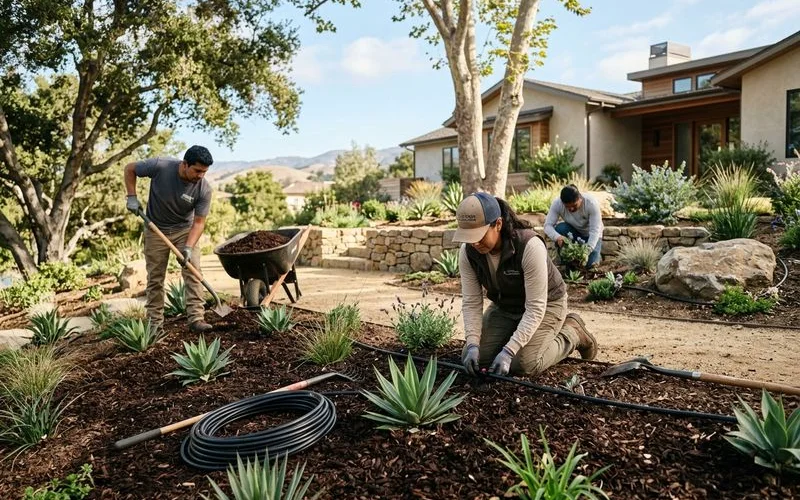
Irrigation retrofits are often one of the smartest upgrades on a hillside. Replacing inefficient spray patterns, correcting pressure issues, and separating plants by water need can dramatically improve performance. It is common to see a hillside where the front-facing shrubs were getting more water than the deep-rooted natives behind them, simply because the system was installed in broad zones rather than by plant function. A little reconfiguration can make the whole landscape more honest.
Mulch also helps. It slows evaporation, cushions rainfall impact, and gives young plantings a better start. On a hillside, mulch should be used with judgment, especially where wind or custom patio design slope can move it. Fine materials can wash downhill if they are not anchored by plants or hardscape. Coarser mulch often stays put better, particularly on the upper slope where runoff can begin.
Hardscaping and planting should be planned together
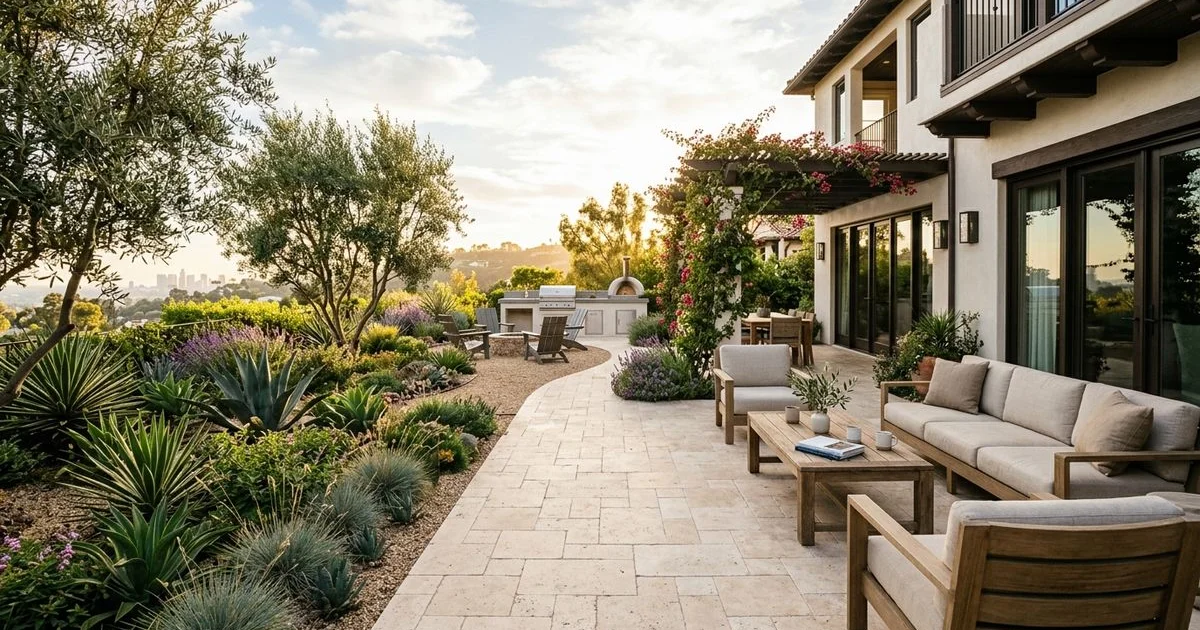
Hillside success usually depends on the relationship between softscape and hardscape. Too often, they are treated separately, and the result is a landscape that looks finished on paper but behaves badly in the rain. Strategic hardscaping can help define grade changes, catch water, and reduce the pressure on plantings. Steps, seat walls, terraces, and retaining elements can all support the hillside instead of forcing it into an artificial shape.
The point is not to pave over the slope. The point is to create smaller, more manageable planting areas where water can be slowed and directed. A terrace with the right planting on top may hold soil better than a broad uninterrupted bank. A narrow hardscaped path can provide access for maintenance without compacting the rooting zone. Even a few carefully placed stones or low walls can interrupt the movement of water long enough for plants to benefit.
When hardscaping is integrated well with landscape design, the hillside starts working like a series of smaller systems rather than one large vulnerable plane. That matters during a hard rain. It also matters during a heat wave, when shading from walls, boulders, and layered plantings can reduce stress in key areas.
Firewise choices are part of good hillside design
In foothill and hillside communities, firewise planning is not an optional layer. It belongs in the first conversation. The San Gabriel Mountains and surrounding areas have landscapes that are naturally beautiful and also ecologically sensitive. Local native plant communities are part of that character, but the planting plan still has to account for defensible space, ember exposure near structures, and material choices close to the house.
That does not mean a hillside has to be stripped bare. It means plant selection and spacing should be intentional. Plants with lower fuel loads near the home, careful separation between shrubs, and maintenance that removes accumulated dead material all make a difference. Many native plants can fit this strategy well when they are placed thoughtfully. The goal is a landscape that is visually strong, ecologically appropriate, and not trying to create a continuous ladder of fuel up to the structure.
A slope can actually benefit from firewise design if the planting is layered and open enough to avoid a dense, uniform mass. That sort of structure also tends to improve water performance. Air moves through the plantings, mulch stays healthier, and maintenance access is easier. Firewise and water-wise are not opposites. On many hillside properties, they are aligned.
Soil stability depends on establishment, not just species
A hardy plant can still fail if it is planted poorly or watered inconsistently during establishment. On a slope, the first year matters a great deal. Roots need time to move outward and downward, and that process is more fragile on hillside terrain than on flat ground. If the root ball dries out repeatedly, or if heavy runoff strips away the top layer of soil, the plant spends its energy surviving rather than anchoring the slope.
This is where patience pays off. New hillside plantings often need closer attention than mature landscapes, especially through the first dry season. Deep but infrequent watering is usually better than frequent shallow watering, though the exact schedule depends on exposure, soil, and the plant palette. You want enough moisture to encourage roots to explore, but not so much that the soil stays saturated or unstable.
It is also worth watching how different parts of the slope respond. A plant at the crest may need more support than one halfway down because it faces more sun and wind. A plant at the toe of the slope may need less frequent watering if runoff naturally collects there. The best hillside managers learn to read those differences instead of applying the same irrigation pattern everywhere.
A few plant combinations that make sense
When people ask for hillside planting ideas, they usually want combinations rather than isolated names. In practice, combinations are what matter. A hillside planting palette can be built around a few strong partners that do different jobs. California buckwheat can provide a durable, sun-loving framework. Foothill penstemon can thread color through the planting without adding much water demand. Bunchgrasses can fill the spaces between larger shrubs and help slow surface movement. Manzanita or ceanothus can give the slope structure and seasonal interest. California sagebrush can soften a harsher edge and blend the planting into the local chaparral feel.
That mix is not arbitrary. It reflects how hillside landscaping works in the real world. Some plants anchor, some fill, some soften, and some provide seasonal movement that keeps the slope from feeling static. A single plant type rarely does all of that well. A layered approach is more resilient and often more attractive over the long term.
There is also a visual benefit to working with native and climate-appropriate plants. The San Gabriel Valley has a distinctive hillside character, and water-efficient planting can still honor that look. The result should feel grounded in the terrain, not imported from somewhere else. That is one reason native habitat gardening has become so relevant. It supports local identity while also answering the practical demands of water conservation and slope management.
HOA rules and water restrictions should not be ignored
Homeowners in HOA communities sometimes assume that association rules will block a water-wise remodel. California water-restriction guidance says homeowners’ associations cannot prohibit certain water-efficient landscaping choices during drought-related restrictions. That does not mean every design decision is free of review, but it does mean that drought tolerant landscaping has legal and practical support in the state.
This matters because hillside properties are often in communities with strong visual standards. Owners may hesitate to move away from turf or ornamental planting because they fear pushback. Yet the broader direction in California favors water conservation, efficient irrigation, and landscapes suited to local climate. If you are planning a hillside remodel, it is sensible to account for both the HOA framework and the state’s water-efficient landscape expectations from the start. That prevents rework later.
Common mistakes that make hillsides fail
Some hillside problems are stubbornly predictable. A steep slope gets planted with species that need more water than the irrigation system can support. A beautiful design ignores drainage and concentrates runoff at one weak point. Turf is removed without replacing the function it used to serve, leaving bare soil exposed while the new plants are still trying to establish. Or the landscape is packed too tightly with shrubs because the owner wants instant coverage, only to discover later that overcrowding creates maintenance and fire concerns.
These problems are avoidable. The solution is not complexity for its own sake. It is restraint, sequencing, and a willingness to let a hillside mature. California-friendly plants often look modest in the first season. That is normal. Many of the best slope plants spend the first year building roots instead of putting on showy top growth. The landscape looks fuller later, after the root system and irrigation have settled into balance.
The same caution applies to stormwater. A hillside should not be treated as if it were a flat lawn with a few shrubs placed on top. Water moves with gravity. Design has to respect that. Small berms, planting pockets, terraces, and properly chosen hardscaping elements can all help, but only if they are coordinated with the plant palette and the drainage pattern.
Making the slope work harder so you do not have to
The most successful hillside landscapes are not the most elaborate. They are the ones that match the site well enough that they need less rescue later. In the San Gabriel Valley, that usually means drought tolerant landscaping, local native plants, efficient irrigation, and a layout that takes erosion seriously from the beginning. It also means accepting that hillside landscaping is a system, not a shopping list.
A good slope can save water, protect soil, support local habitat, and still look beautiful through the dry season. That is the real promise of thoughtful planting. Not perfection, and not a picture-perfect finish on day one, but a landscape that grows into its place and keeps earning its keep year after year.
When the design respects sun exposure, drainage, firewise concerns, and the practical limits of irrigation, the hillside becomes an asset rather than a liability. That is the standard worth aiming for.