
How to Create a Low-Water Garden with Climate-Appropriate Plants
A low-water garden works best when it is treated as a system, not as a shopping trip. The strongest results come from matching plant choices to sun exposure, soil, slope, irrigation performance, and the way water actually moves across a property. That approach matters even more in places like the San Gabriel Valley, where drought-tolerant landscapes, hillside conditions, and firewise planting often overlap. A garden can look layered, intentional, and full of life without asking for constant irrigation, but it takes planning up front and some honest assessment of what the site can support.
The temptation is usually to start with color or with a plant list. That is backward. A climate-appropriate garden begins with the ground under your feet, the amount of direct sun each area receives, and whether water soaks in, runs off, or pools. California’s water conservation guidance puts those questions first for a reason. If the landscape is redesigned around what the site already does well, irrigation becomes simpler, plant losses drop, and maintenance gets easier over time.
Start with the site, not the wishlist
Every low-water landscape starts with observation. Walk the property at different times of day and pay attention to the places that heat up fastest, the corners that stay shaded, and the slopes where water moves after a hose or irrigation cycle. In the San Gabriel Valley, that can mean a front yard that gets a full afternoon blast, a side slope that sheds water quickly, and a back garden that behaves very differently because of shade from walls, fences, or nearby trees.
Soil matters just as much as sun. A sandy patch drains fast and may need plants that can handle dry conditions with minimal extra help. Heavier soil holds moisture longer but can create runoff if irrigation is too fast or if the slope is steep. Before removing turf, it is worth understanding these basics because a low-water garden does not succeed by starving plants, it succeeds by giving each planting zone the right amount of water at the right time.
Microclimates can be surprisingly small. A plant that thrives in an open, breezy exposure may sulk near a south-facing wall that radiates heat late into the evening. Likewise, a plant that looks fine in a half-day sun bed may decline when placed in a fully exposed front strip. This is where landscape design becomes practical rather than decorative. The goal is not to make every part of the yard identical. The goal is to place the right material in the right microclimate and let the site do some of the work.
Think in plant communities, not isolated specimens
Climate-appropriate planting is easier when you stop trying to force unrelated plants into the same bed. In a low-water garden, the strongest combinations usually come from species with similar water needs and similar sun tolerance. That is one reason native and regionally adapted plants are so useful. They are already accustomed to the seasonal rhythm of California landscapes, where wet periods do not last forever and summer irrigation must be used carefully.
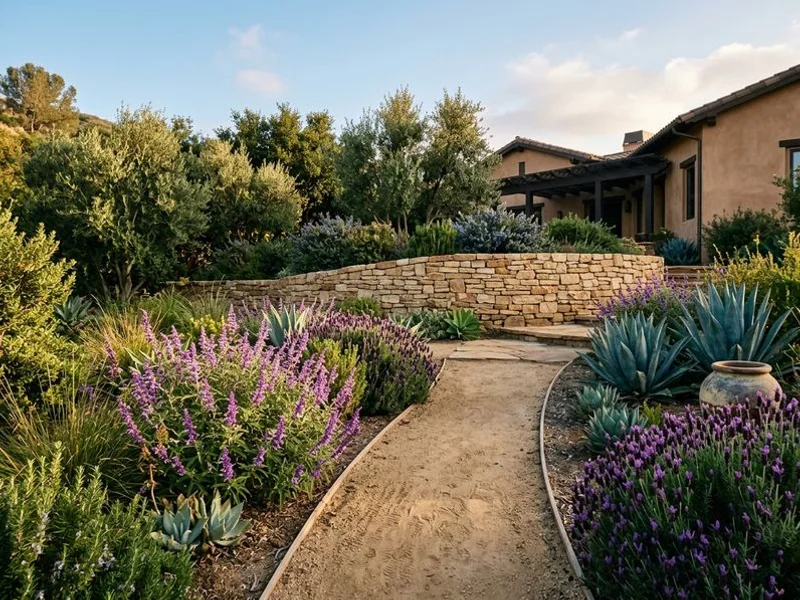
For the San Gabriel Valley and nearby foothill settings, that often means working with plants such as California buckwheat, California sagebrush, manzanita, ceanothus, monkeyflower, foothill penstemon, bunchgrasses, and locally named natives such as San Gabriel oak where appropriate to the site. These are not interchangeable, and they do not all behave the same way, but they share a design advantage: they fit the climate instead of fighting it.
A good low-water design has texture across the seasons. Bunchgrasses give movement and structure. Shrubs such as ceanothus or manzanita can anchor a bed. California sagebrush brings a lighter, more open character that works well in larger drifts. Monkeyflower and foothill penstemon provide seasonal color without demanding the constant watering that many common ornamentals expect. When grouped thoughtfully, these plants create a garden that feels cohesive rather than assembled from leftovers.
There is also a practical benefit to planting in compatible groups. Irrigation can be zoned more accurately when one section contains plants with similar water demand. That reduces waste and helps prevent the common problem of overwatering one plant to save another. In drought resistant landscaping, that kind of mismatch is one of the biggest causes of mediocre performance.
Turf removal is only the beginning
Many people think low-water landscaping begins and ends with taking out lawn. Turf removal is often the right move, especially where irrigation demands are high and the lawn is not being used heavily. But removing grass alone does not create a good garden. It creates a blank surface that still needs a plan.
California water conservation guidance encourages homeowners to assess irrigation, soil, sun exposure, and plant selection before removing turf. That sequence matters. If a lawn is removed without rethinking irrigation and drainage, the result can be erosion, dust, dead spots, or plant failure. A dry yard is not automatically a low-water garden. Sometimes it is just an unfinished one.
The best turf conversions usually happen in stages. First, reduce the high-water footprint. Then reshape beds so the space feels intentional. Then install climate-appropriate plants in grouped zones. Finally, adjust irrigation to match the new layout. The point is to avoid the common mistake of ripping out a lawn and replacing it with a handful of isolated shrubs sitting in bare mulch. That kind of project may use less water, but it usually lacks the structure and resilience people actually want.
When turf comes out, the soil underneath often needs attention. Lawn soil can be compacted, uneven, or poorer in structure than expected. It may hold water differently after the grass is gone. A low-water garden benefits from a surface that accepts irrigation slowly and evenly, not from a patchy base that sheds water down the driveway.
Use hardscaping to shape the garden, not dominate it
Hardscaping can make a low-water landscape more practical, especially where the site needs circulation, erosion control, or a place to gather. Pathways, gravel bands, boulders, retaining elements, and seat walls can define the space and reduce the amount of planting needed in high-stress areas. Done well, hardscaping helps the garden read as complete even when plantings are still young.
This is especially useful in hillside landscaping. Slopes often need more than plants alone. They may need step-down paths, drainage management, or structural elements that slow runoff and hold soil in place. On a slope, the question is not just what looks good, but what keeps the hillside stable when irrigation starts and rain returns. Plants with strong root systems help, but design has to account for water movement before it becomes a problem.
Hardscaping also gives you a way to work with firewise landscaping goals. In some settings, especially near the San Gabriel Mountains and other foothill areas, plant placement and surface choices matter as much as species selection. A well-planned hardscape can create defensible-space logic without making the garden feel stripped bare. The best versions are calm, durable, and visually tied to the planting around them.
The trade-off is simple. More hardscape means less living coverage, so it should be used where it serves a clear purpose. Too much can make a yard hot and harsh. Too little can leave a slope exposed or a circulation path muddy and awkward. Good landscape design uses hardscaping as a framework, not as the whole story.
Design for slopes, runoff, and erosion before you choose finishes
Hillside properties are common enough in the region that slope logic should be part of the first sketch, not an afterthought. On a slope, water speed becomes the main issue. Even a modest irrigation cycle can cause runoff if the application rate is too fast or the soil is compacted. That is why erosion control and drainage deserve as much attention as the planting palette.
One practical lesson from hillside landscaping is that water should be slowed, spread, and sunk where possible. That means thinking about how beds are shaped, where mulch will stay in place, and how irrigation reaches the root zone. Plants selected for slopes should be drought tolerant, but they also need to hold soil. Ground-hugging shrubs, bunchgrasses, and rooted natives often do more useful work than thirsty ornamentals that look tidy for a season and then fail under heat and exposure.
A slope can also become a visual feature instead of a problem. In the San Gabriel Valley, hillside landscapes contribute to the area’s character, so the goal is often to keep that open, water-wise look while making the site more stable and lower maintenance. That balance is possible, but it depends on being honest about the slope’s limits. The steeper the area, the more hardscaping contractors Pasadena important drainage, plant spacing, and irrigation control become.
Choose irrigation that matches the new planting
A climate-appropriate garden still needs water, especially during establishment. The difference is that it should receive water efficiently and in quantities suited to the plants and the season. Irrigation retrofits are often the hidden key to success. Drip systems, properly grouped zones, and corrected spray patterns can make a larger difference than adding more mulch or buying more expensive plants.
In practice, the most useful irrigation upgrade is the one that reduces overspray and applies water where roots can use it. Watering pavement, fences, and decomposed paths helps nobody. A low-water garden should be irrigated with enough precision that each zone gets what it needs without encouraging weeds or runoff. That is particularly important on slopes, where fast application rates can send water downhill before it has a chance to soak in.
California’s Model Water Efficient Landscape Ordinance also reinforces the importance of water-efficient planning in new and renovated landscapes. That is not just a regulatory point. It reflects a design reality. Landscapes perform better when irrigation and plant selection are coordinated instead of treated as separate decisions. If the irrigation system is mismatched to the new garden, the planting plan will always be working uphill.
There is also a maintenance point that often gets overlooked. A retrofit is easier to manage when the zones are simple and logical. If one valve serves thirsty and dry-loving plants together, the gardener will eventually overwater something. Good systems are not necessarily elaborate. They are clear.
Firewise and low-water can work together
People sometimes assume that a low-water landscape has to look sparse or severe to be safer around fire. That is not the case. Firewise planting and water-wise planting often overlap, especially when the design uses well-spaced plants, clean lines, and sensible materials. The San Gabriel Mountains region makes this connection especially relevant, since local guidance emphasizes ember-resistant zone rules and native plants suitable for local gardens.
The most reliable approach is to use climate-appropriate plants that are not overly dense, keep them well maintained, and avoid piling combustible debris near structures. Plant selection matters, but so does spacing and maintenance. A plant that is suitable in principle can become a problem if it is crowded, dried out, or left with dead material accumulating in the center.
That is another reason to prefer resilient natives and adapted species over high-demand ornamentals. Plants that belong in the climate are generally easier to maintain at healthy moisture levels. Health is part of firewise strategy. A stressed garden is rarely a stable garden.
HOA restrictions should not be the first obstacle
For many homeowners, the barrier to a low-water garden is not design, it is fear of what an HOA might say. That concern is understandable, especially in communities with strict visual rules. California’s water-restriction guidance is helpful here because it makes clear that homeowners’ associations cannot prohibit certain water-efficient landscaping choices during drought-related restrictions.
That does not mean design standards disappear. It does mean homeowners have room to pursue drought tolerant landscaping, turf reduction, native plantings, and efficient irrigation without being blocked simply because the result looks different from a traditional lawn. In areas where the visual character of the neighborhood matters, this is where good landscape design earns its keep. A thoughtful low-water garden can look refined, orderly, and regionally appropriate rather than improvised.
The most successful HOA-friendly projects usually share a few qualities: crisp edges, repeating plant drifts, restrained material choices, and a sense that every element belongs where it is. These gardens do not rely on quantity. They rely on consistency.
A simple way to build the garden in phases
A full transformation does not have to happen in one expensive burst. Many of the best gardens are built gradually, with each phase informing the next. First, confirm the site conditions. Then reduce turf or other high-water areas. Then install irrigation improvements and erosion control where needed. Finally, add climate-appropriate plants in groups that make sense for sun and slope.
If the site has a hillside component, start with stability and water movement. If the front yard is the weak point, start there because it shapes the first impression. If the backyard is used heavily, preserve the usable space and concentrate low-water planting where it will create the most impact without getting trampled.
A few practical habits make a big difference during the first year. Water new plantings deeply enough to establish roots, but do not assume all plants need the same schedule. Watch how long the soil stays moist after each irrigation. Adjust for hot exposures, reflected heat, and shade. Replace plants based on performance, not hope. A low-water garden is refined over time, not perfected on day one.
If you want the garden to feel abundant, use repetition and structure rather than excess water. A repeated shrub on a slope, a band of bunchgrasses along a path, or a drift of monkeyflower under a tree can create more visual coherence than a mixed collection of unrelated plants. This is where hardscaping and planting support each other. A few clean edges and well-placed anchors let the living material do more expressive work.
What a good low-water garden feels like
The best climate-appropriate gardens are not trying to look deprived. They feel settled. They read as part of the region. They move with the terrain instead of pretending the terrain is flat and uniform. In the San Gabriel Valley, that often means native and adapted plants, careful irrigation, smart erosion control, and a design that respects both the hillside and the heat.
A well-built low-water garden does not ask for constant rescue. It settles in, asks less of the hose, and gives more in return through texture, seasonal change, and a sense of belonging to the place. When it is designed with the site in mind, drought resistant landscaping can be practical, elegant, and surprisingly forgiving. The real skill lies in restraint, in choosing plants and materials that fit the climate rather than fighting it, and in letting the landscape become what the land can actually support.