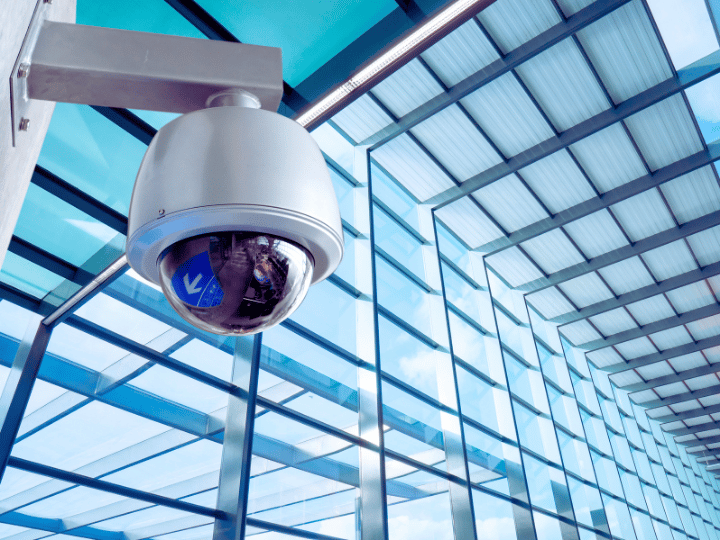
The federal Bank Protection Act requires banks to maintain security devices and procedures to discourage robberies, burglaries, and larcenies and to help identify and apprehend offenders, so a branch's cameras and alarms are an obligation, not an option.
Cameras in a bank are placed to capture clear identification at the door, the teller line, and the ATM, a higher standard than general surveillance, because the footage may become evidence in an investigation that begins weeks later.
A holdup alarm lets bank staff signal for help without alerting a robber, sending an immediate alert to a monitoring center and law enforcement, which is why it is a standard layer in every branch's security system.
Cameras in a bank do a specific job: capture clear, usable identification of everyone who enters and everything that happens at the teller line, the entrances, the ATM, and the vault. That is a higher standard than general surveillance, because the footage may become evidence. Bank security systems place high-resolution cameras to capture faces at the door and at each teller station, cover the ATM and night-drop, and watch the parking lot and perimeter. Wide dynamic range handles the bright, backlit glass entrances common to branches, so a face is visible against daylight rather than lost in shadow.
The video management behind those cameras matters as much as the cameras. Footage has to be retained long enough to serve an investigation that may not begin for weeks, and it has to be searchable so an investigator can find a specific person or transaction quickly. Mammoth Security records to enterprise video management platforms such as the Avigilon Control Center, ExacqVision, and Milestone, and works with NDAA-compliant camera lines, Avigilon, Axis, and Hanwha Vision, which matters for institutions handling government or federally connected accounts.

A bank runs on controlled access. The public reaches the lobby, but the teller area, the vault, the cash room, the safe-deposit area, and the back offices must stay restricted to authorized staff, and every entry must be logged. Access control with electronic credentials handles this, and it ties directly to the branch's accountability: when a controlled door opens, the system records who opened it and when. Time-based permissions can limit access to business hours, and dual-authorization can require two credentials to reach the most sensitive areas. Mammoth Security designs this access structure around the branch's real zones and staff.
The vault and cash areas add their own layer. Alarms on the vault, duress and holdup alarms at the teller line that let staff signal for help silently, and monitored intrusion detection after hours all protect the parts of the branch a robber targets. Paired with 24/7 central station monitoring, a holdup or burglar alarm reaches a monitoring center that notifies law enforcement immediately. For a bank, that monitored response is not a convenience; it is a core protection that regulators expect.
The strength of modern bank security systems is that the pieces work together. Integrated with access control, a camera pairs a door event with the video of it, so a security officer reviewing an incident sees who badged through a door and watches the clip at once. A holdup alarm can flag the relevant cameras for a monitoring operator. Integrated with the point-of-transaction record where appropriate, video ties an event to its detail. That integration turns a set of separate devices into one system a bank's security officer can actually use during and after an incident.
Connecticut and Massachusetts have a dense network of community banks, credit unions, and regional branches, and each has the same core needs scaled to its size. A single community branch needs the full stack, cameras, access control, vault and holdup alarms, and monitoring, sized to one building, while a multi-branch institution needs that same setup standardized across locations and managed from one platform. Mammoth Security serves both, bringing the same integrated approach whether an institution runs one branch or a regional network, from its New Haven office and additional Connecticut locations.
The consistency matters for a multi-branch institution. When every branch runs the same integrated bank security systems on one management platform, a security officer monitors the whole network from one place, holds each location to the same standard, and calls one company for service. That standardization simplifies both daily oversight and the examinations that financial institutions face.
Mammoth Security uses in-house W-2 technicians, not subcontractors, which matters for a bank both for accountability and for the discretion these installations require. The same team that designs a branch's system installs and services it, so a camera that drops offline or a reader that fails is handled by people who know the system. As a licensed Connecticut security and low-voltage contractor with four locations and more than 5,000 buildings secured, Mammoth brings the depth a financial institution needs alongside the local response a branch depends on.


No two branches are identical, and bank security systems scale to the format. A full-service branch with a teller line, vault, and safe-deposit area needs the complete stack of identification cameras, access control, and vault and holdup alarms. A drive-through adds cameras and communication at each lane. A standalone ATM or an ATM vestibule needs its own coverage, because the ATM is a frequent target and its footage is often the evidence that identifies a card-skimming or robbery suspect. A branch inside a supermarket or a shared building needs coverage that works within that host environment. Mammoth Security designs the security to the branch format rather than applying one template to every location.
Bank installations demand discretion and clean documentation, and both favor an integrator with its own accountable staff. The people working inside a branch handle sensitive areas, so a bank benefits from in-house W-2 technicians rather than a rotating cast of subcontractors. The system also has to be documented, its cameras, retention, and coverage recorded, so the institution can show examiners that its security devices meet the standard the Bank Protection Act expects. Mammoth Security documents its installations and services them with its own team, which is part of what makes it a fit for financial institutions rather than a general installer.
A bank's alarms are only as good as the response behind them. Mammoth Security provides 24/7 central station monitoring for fire, burglar, and holdup alarms, so an alarm at any hour reaches a monitoring center that notifies the fire department or law enforcement immediately. A 24/7 answering service and emergency response back that monitoring, so a branch is never left waiting when a system triggers. For a financial institution, that around-the-clock coverage is the layer that turns detection into response, and it is a standing expectation of the regulators who examine the branch.

For a bank with more than one branch, consistency is its own protection. When every location runs the same integrated bank security systems on one platform, the institution's security officer holds all of them to a single standard, monitors the whole network from one place, and works with one vendor across every branch. Opening a new branch becomes a repeat of a proven system rather than a fresh problem, and an examination is simpler when every location follows the same documented approach. Mammoth Security's statewide reach and in-house team make that consistency practical across Connecticut and Massachusetts.
The institutions that protect their branches, staff, and customers best are the ones that treat security as one designed system rather than a collection of devices added over the years. Identification-grade cameras, controlled access to every sensitive area, monitored vault and holdup alarms, and the integration that ties them together form the layered protection a bank needs and its regulators expect. That is the standard Mammoth Security brings to financial institutions across Connecticut and Massachusetts.
From a single community branch to a regional network, the same principle holds: a bank's security has to deter, document, and comply, all at once. An integrator that understands what a financial institution needs, and that installs and services the system with its own accountable people, is what protects the branch and satisfies the examiner. Mammoth Security brings that combination to banks and credit unions across Connecticut and Massachusetts, from its New Haven office and additional locations statewide.
For a Connecticut or Massachusetts financial institution weighing surveillance, access control, vault and holdup alarms, and monitoring, the starting point is a free on-site assessment. To plan bank security systems for your branches, contact Mammoth Security Inc. at (860) 532-6714 for a no-obligation written quote.
Redirect to:
|
This page is a redirect. The following categories are used to track and monitor this redirect:
|