
Drought-Tolerant Landscape Design with Local Native Species
A well-designed drought-tolerant landscape does more than save water. In the San Gabriel Valley, it also has to respond to hillside conditions, erosion pressure, firewise planning, and the visual character of a region where slopes, canyons, and foothill properties shape how outdoor space feels and functions. That is why the most successful landscape design in this part of California rarely starts with a plant palette alone. It starts with the ground, the drainage, the sun exposure, and the way a property behaves through heat, wind, and rain.
When a landscape is built around local native species, the result can be both practical and place-specific. California native plants evolved with the climate patterns that define much of Southern California, and many of them fit naturally into drought resistant landscaping. They can reduce irrigation demand, support habitat, and hold their own in the dry, exposed conditions common on slopes and open lots. But the phrase “native plant landscape” can be misleading if it suggests a simple swap of turf for shrubs. The real work lives in the details, especially where hardscaping, soil, and water management intersect.
Start with the site, not the plant list
The California water agency recommends a straightforward sequence before removing turf or redesigning a landscape: assess irrigation, soil, sun exposure, and plant selection. That order matters. It is tempting to begin with favorite species, but that often leads to mismatches. A plant that looks perfect in a nursery container may struggle in full afternoon sun, compacted soil, or a slope where runoff is too fast for roots to establish.
In practice, site assessment answers questions that shape the whole project. Where does water collect after rain, and where does it disappear too quickly? Which zones bake in western exposure? Which areas sit under reflected heat from masonry walls, driveways, or retaining features? Even a small yard can have several microclimates, and those differences matter when choosing plants for drought tolerant landscaping.
Soil deserves particular attention because it affects both water retention and plant anchoring. A slope with thin soil needs a different strategy than a level planting bed with deeper topsoil. Irrigation should be evaluated as well, not assumed to be adequate just because heads are present. Older systems often overwater one area while leaving another dry, which creates a false picture of plant health and wastes a surprising amount of water. If the goal is water-wise design, the irrigation system has to be part of the diagnosis, not an afterthought.
Why local native species belong in the conversation
Local native species bring something to a landscape that imported ornamentals often cannot match: they are already adapted to the regional climate and the kinds of seasonal stress that come with it. In the San Gabriel Valley, that means hot, dry periods, periodic wind, and landscapes that often include slopes or rough transitions between built surfaces and natural terrain.
Species such as California buckwheat, California sagebrush, manzanita, ceanothus, monkeyflower, foothill penstemon, and bunchgrasses can all play a role in a drought tolerant design when they are matched to the right conditions. San Gabriel oak is another locally named native species that belongs in regional conversations about habitat-oriented planting. These are not filler plants. They bring texture, seasonal change, and in many cases valuable ecological function.
Native plantings also fit the broader water-conservation framework used in California landscape planning. The state’s Model Water Efficient Landscape Ordinance regulates water usage in new and renovated landscapes and encourages native or climate-appropriate plants, efficient irrigation, and alternative water sources. That matters because water-wise design is not just a stylistic preference. It is part of how landscapes are expected to perform in new construction and renovation work across the state.
A common mistake is assuming that native always means low maintenance in every setting. That is too simple. Native plants are often well suited to regional conditions, but they still need thoughtful placement, establishment care, and sensible irrigation during the first stages of growth. The advantage comes from matching species to microclimate and soil, not from planting them anywhere and expecting them to solve every problem by themselves.
Hillside landscaping changes the rules
Hillside landscaping in the San Gabriel Valley carries its own set of concerns. Slopes are vulnerable to erosion, especially when soil is disturbed or left exposed during construction. They also tend to dry out faster than level ground, which increases stress on new plantings. On top of that, hillside properties often sit in visually prominent areas, so the landscape has to work from both a technical and aesthetic standpoint.
That is why drought-tolerant planting on slopes is rarely only about beauty. It is about slope stability, runoff control, and selecting plants that can anchor soil while still handling drought and firewise requirements. CNPS has emphasized that slopes need erosion control, drought tolerance, and firewise planting, a combination that fits the foothill and hillside properties common in the area.
Hardscaping plays an important supporting role here. On a steep property, steps, terraces, retaining elements, and strategically placed paths can reduce runoff and make a hillside more usable. The key is restraint. Too much hard surface can increase stormwater speed and leave fewer places for infiltration, while too little structure can make a slope hard to maintain. The best hillside landscaping uses hardscaping to manage movement across the site, then softens it with planting that is dense enough to hold soil but not so crowded that it creates avoidable competition for moisture.
A hillside can also reveal where drainage design has been neglected. Water that rushes off a driveway or roof edge and onto a slope can carve channels over time. Proper grading, infiltration-minded planting, and well-placed hardscape details help prevent that damage. In a region where drought and sudden rain can coexist in the same season, that balance is not optional.
Firewise planning belongs in water-wise design
In the San Gabriel Mountains region and nearby hillside communities, firewise planting is part of responsible landscape planning. The local CNPS chapter highlights ember-resistant zone rules and native plants suitable for local gardens. That is an important reminder that drought tolerant landscaping should never ignore fire behavior. Dry conditions, wind, and slope all affect risk, and the landscape can either reduce exposure or make conditions worse.
Good firewise design is not about stripping a property bare. It is about choosing plants and arranging them in ways that reduce fuel continuity and support defensible-space planning. Many native plants can be part of that approach when they are selected and maintained carefully. A landscape full of overgrown, woody material right up against a structure is a different matter than a layered planting with sensible spacing, clean edges, and clear transitions near buildings.
I have seen projects where a homeowner assumed that “native” alone was enough protection. It was not. A native plant can still be poorly placed, overgrown, or packed too close to a wall. Firewise design depends on both species selection and maintenance discipline. That includes pruning, debris removal, and avoiding the kind of dense clutter that traps dry material near structures. For properties near the foothills, the objective is to combine ecological fit with clear, practical defensible-space planning.
Turf removal should be deliberate, not impulsive
Turf removal is often part of drought resistant landscaping, but it should be handled carefully. The California guidance is clear that homeowners should assess irrigation, soil, sun exposure, and plant selection before removing turf. That order is useful because grass removal changes how a site behaves. Turf typically provides a uniform surface, even if it is water intensive. Once it is gone, bare areas can become heat islands, erosion can increase, and poor soil can become more obvious.
A successful turf conversion starts with a plan for what replaces the lawn in each zone. In some areas, that may be native shrubs and grasses. In others, it may be a mix of hardscaping and low-water planting beds. In a sloped yard, the answer may include terracing or other structural elements to slow runoff. The goal is not to eliminate green space entirely. It is to create a landscape with lower water demand and better long-term fit for the site.
This is also where plant selection by microclimate becomes practical rather than theoretical. A sunny front yard, a shaded side yard, and a hot slope need different plant communities. If all three areas are designed from the same template, some parts will overperform while others struggle. Turf removal gives you a chance to correct that imbalance, but only if the replacement plan respects the differences already present in the yard.
Irrigation retrofits can make or break the project
Efficient irrigation is one of the least glamorous parts of landscape design, but it often determines whether a planting thrives or fails. The state’s water-efficient landscape framework encourages efficient irrigation, and that is sensible. A drought tolerant landscape still needs water during establishment, and even mature native plants benefit from targeted delivery when conditions are extreme.
The challenge is not simply reducing water. It is applying the right amount in the right place. Retrofit work often reveals inconsistent pressure, uneven coverage, or legacy systems that were built for turf rather than mixed planting beds. If you are moving from lawn to native planting, the old system may no longer make sense. Drip irrigation, pressure regulation, and zone separation can improve efficiency, but only if they are matched to the planting design and maintained properly.
There is also a real trade-off between irrigation simplicity and plant diversity. A single irrigation schedule may be convenient, but it can force incompatible plants into the same water regime. That is one reason landscape design should group plants with similar water needs rather than treating the whole yard as one uniform zone. WUCOLS is a useful reference point for understanding region-appropriate plant water needs, and that kind of resource helps separate what looks attractive from what actually fits the climate.
What a good plant palette looks like in practice
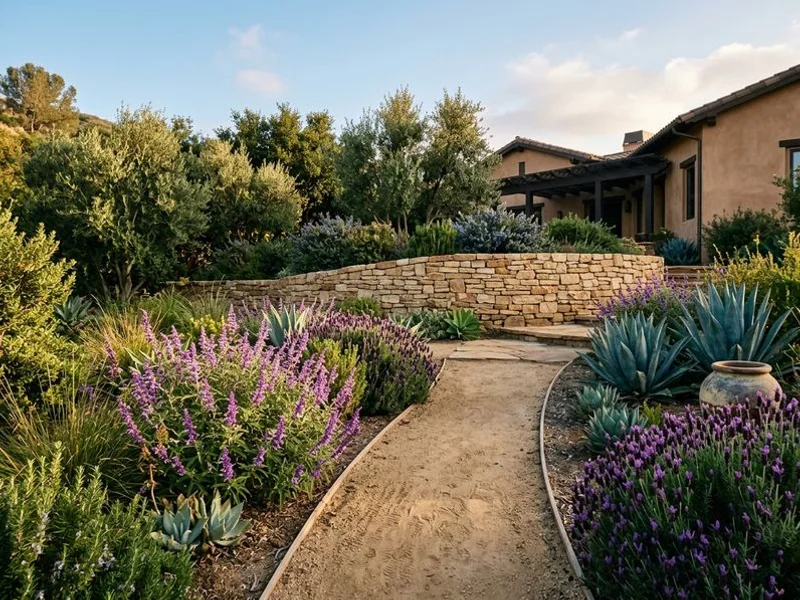
A strong drought-tolerant planting scheme is usually layered, not scattered. It combines structural plants, lower-growing species, and ground-hugging or bunchgrass elements in a way that supports both visual interest and function. The exact mix depends on sun, slope, and soil, but the plants themselves should reinforce the site rather than fight it.
A practical palette for local native species often includes plants with different textures and growth habits so the landscape feels complete without needing high water inputs. Consider this kind of grouping as a custom landscape installations starting point rather than a rigid formula:
- California buckwheat for structure and seasonal character
- California sagebrush for a loose, regional look
- Ceanothus or manzanita for backbone and form
- Monkeyflower and foothill penstemon for color and detail
- Bunchgrasses to knit spaces together and help with erosion control
That mix is useful because it spreads visual interest across the year and gives the landscape different layers of resilience. The grasses help soften transitions. The shrubs provide form. The flowering species bring seasonal variation without demanding a high-water lawn regime. On a hillside, these layers also help stabilize soil and break up runoff paths.
The exact spacing and arrangement matter just as much as the plant names. If everything is packed too tightly, the planting can become hard to maintain and overly competitive for water. If it is too sparse, soil remains exposed and erosion increases. Good landscape design lives in that middle ground where plants can establish, breathe, and still cover enough soil to do real work.
San Gabriel Valley properties need design that respects place
The San Gabriel Valley has a distinctive hillside visual character, and that should influence how drought-tolerant landscapes are composed. New construction and renovated properties in the region increasingly need water-efficient landscapes that fit local conditions. A landscape that ignores the slope, the views, or the surrounding plant communities can feel forced, even if it is technically low water use.
This is where native habitat gardening becomes more than a trend. It helps a property feel tied to the region, especially when the planting reflects the surrounding foothill ecology. At the same time, homeowners and designers have to work within practical constraints, including local rules, water efficiency standards, and sometimes HOA expectations. California water-restriction guidance says homeowners’ associations cannot prohibit certain water-efficient landscaping choices during drought-related restrictions, which is an important point for anyone dealing with community guidelines while trying to reduce water use responsibly.
That said, even when an HOA permits a landscape direction, the design still has to be defensible. A native garden that is not maintained can look unkempt, and a slope that is beautifully planted but poorly drained can still fail. The best projects are the ones where aesthetics, ordinance awareness, and site performance all move together.
The landscapes that age well are usually the ones that were planned honestly
The most reliable drought-tolerant landscapes are rarely the flashiest at install. They are the ones built on a realistic read of the site. They account for irrigation efficiency, soil condition, sun exposure, and the way water moves during both routine watering and storm events. They use hardscaping when structure is needed, but they do not lean on it so heavily that the yard loses permeability or becomes visually harsh. They choose native species because those plants belong to the region, not because “native” has become a slogan.
That level of planning matters even more on hillside properties, where erosion, drainage, and firewise concerns sit right on top of water conservation goals. A slope that is planted thoughtfully with local natives, supported by the right hardscaping, and irrigated efficiently will usually outperform a landscape that was designed from a catalog of attractive but mismatched plants.
The real promise of drought resistant landscaping is not a dry, minimal yard. It is a landscape that uses less water because it is better matched to the environment. In the San Gabriel Valley, that means reading the land carefully, choosing species with restraint, and respecting the practical realities of slopes, runoff, and wildfire exposure. When those pieces line up, the result is not just sustainable on paper. It feels settled, regional, and built to last.