
Firewise Landscape Planning for Homeowners Associations
Homeowners associations in fire-prone, water-conscious places face a planning problem that is more practical than glamorous and far more important than most committees admit at first glance. A landscape has to look unified from the street, support property values, use water responsibly, handle slopes and drainage, and reduce wildfire exposure at the same time. In the San Gabriel Valley and the foothill communities around the San Gabriel Mountains, that balancing act is not abstract. It shapes what gets planted, how irrigation is designed, how turf is reduced, and how common areas age over time.
The best firewise landscape planning does not start with a shopping list of plants. It starts with the site itself. Sun exposure, soil, irrigation performance, slope, and the way wind and runoff move through the property all determine whether a design will hold up. That is especially true for HOA landscapes, where one weak link in a common area can affect many homes at once. A slope that sheds water too quickly, a strip of thirsty turf nobody really needs, or a dense planting bed tucked against a structure can create headaches that are expensive to fix later.
Why firewise planning and water-wise design belong in the same conversation
For many associations, firewise landscaping used to mean one thing and one thing only, keeping plants away from buildings. That is too narrow. In California, water efficiency is not a side issue, it is part of the design brief. The state’s water guidance encourages property owners to assess irrigation, soil, sun exposure, and plant selection before removing turf, and it points to region-appropriate water needs rather than broad assumptions about what is “low water.” That matters because the wrong plant in the wrong place can fail just as surely as an overwatered lawn.
The same principle applies to firewise design. A plant that looks good in a nursery container may be a poor choice for a hillside, an exposed corner, or a high-traffic common area if it needs frequent irrigation or forms dense, combustible mass near structures. On the other hand, a landscape built around drought resistant landscaping principles can also be cleaner from a fire-risk standpoint when it uses well-spaced, climate-appropriate plants, efficient irrigation, and hardscaping where living cover is hard to sustain.
HOAs often discover this only after a costly retrofit. A board approves a turf reduction project because water bills are climbing. Then the replacement planting bed struggles because the slope is too steep, the irrigation coverage is uneven, or the plant palette was chosen for appearance alone. Firewise planning avoids that trap by treating water conservation, plant health, erosion control, and defensible-space logic as one system.
Start with the site, not the catalog
The most reliable landscape design decisions come from a close read of the property. Two adjoining associations can have completely different needs because one sits on flat ground with deep shade and the other faces full afternoon sun on a hillside landscaping condition where runoff moves fast and soil dries quickly. A good plan accounts for microclimate before it chooses any plants.
That site review should include where the sun hits hardest, where irrigation oversprays onto pavement, where drainage collects after rain, and where slopes are already showing signs of erosion. If a property has older turf that stays patchy despite regular watering, it may be a sign that the lawn was never well matched to the location in the first place. In those cases, reducing turf can be a sound move, but only if the replacement plan also fits the site conditions.
California’s water guidance is useful here because it asks property owners to think in the right order. Look at irrigation, soil, sun exposure, and plant water needs before making major changes. That approach helps HOAs avoid the common mistake of replacing a water-hungry lawn with a bed full of plants that are equally needy, just arranged differently.
What firewise planting actually looks like on an HOA property
Firewise planting is often misunderstood as a ban on shrubs or a push toward bare ground. Neither approach makes sense in a living community. Bare soil erodes, especially on slopes. Sparse plantings can look unfinished and invite weeds. The stronger model is a layered landscape that uses plants thoughtfully, spaces them to avoid continuous fuel, and keeps the most vulnerable areas close to structures especially disciplined.
In the San Gabriel Valley, region-appropriate native and climate-adapted plants can do a lot of the heavy lifting. California buckwheat, California sagebrush, manzanita, ceanothus, monkeyflower, foothill penstemon, bunchgrasses, and San Gabriel oak are all examples of plants that fit the local conversation about native habitat gardening and water-wise design. They are not magic bullets, and each species still needs to be placed where it can perform well, but they give HOAs a palette that supports both conservation and local character.
The point is not to replace every existing planting with a native-only scheme. That is rarely realistic for a large community. The point is to use plants that match exposure, slope, and water availability, then place them in a way that avoids the dense, continuous mass that makes fire spread easier. A healthy, open design with proper maintenance is far better than a crowded bed of stressed plants.
In many common areas, that means choosing plants for function first and appearance second, then refining the look through massing, repetition, and clean edges. The result can still be attractive, sometimes more attractive than the old turf-and-shrub formula, because the texture is richer and the landscape reads as intentional rather than generic.
Hardscape, drainage, and the parts of the site that do not burn
Hardscaping plays an underappreciated role in firewise landscape planning. It is not just a visual accent or a convenient way to reduce maintenance. Properly used, hardscaping helps break up fuel, direct movement through the site, and make drainage work harder for the property instead of against it.
On HOA properties, a few well-placed hardscape elements can solve multiple problems at once. A decomposed granite path, retaining edge, permeable walkway, or stone transition near a structure can help define defensible space while also reducing erosion pressure on a slope. But hardscape should never be treated as a substitute for drainage planning. If runoff is not managed, water will find weak points, undermining walls, washing out planting beds, and damaging pavement.
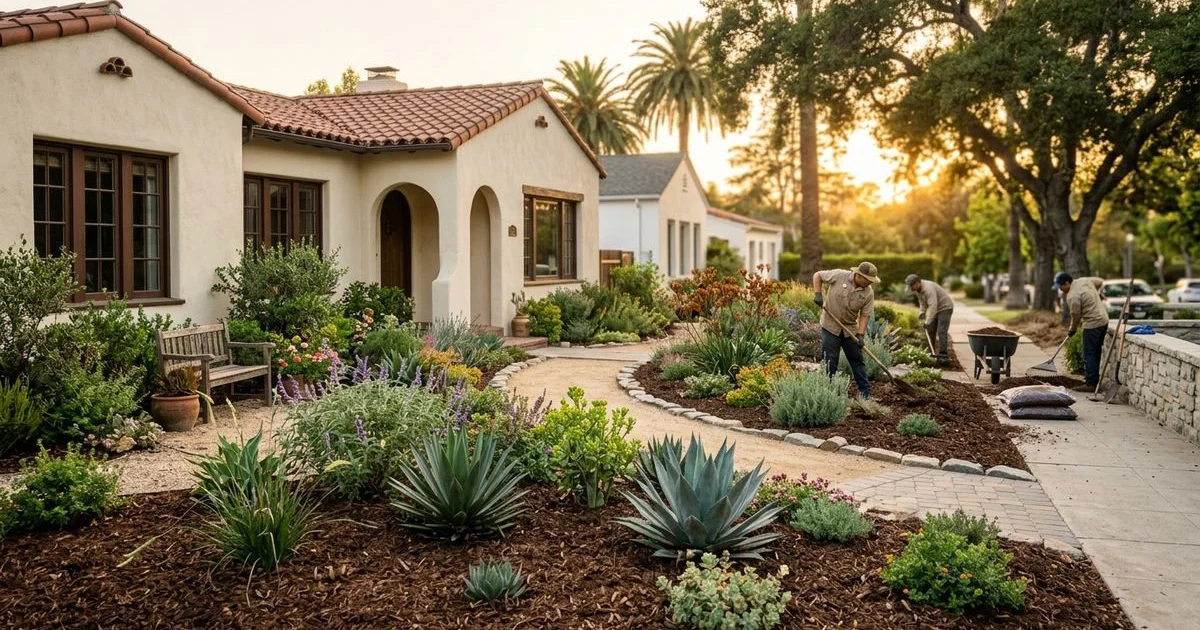
This is where the practical side of landscape design shows up. A water-wise plan that ignores stormwater runoff usually creates new problems after the first heavy rain. In hillside communities, especially, the landscape has to hold soil in place without trapping water against structures. That can mean adjusting planting density, using erosion-control materials where needed, and making sure irrigation does not saturate a slope that already drains poorly.
Associations sometimes hesitate to spend money here because drainage upgrades are less visible than a new entry planting. Yet they are often the difference between a landscape that ages gracefully and one that starts failing within a few seasons. A good board understands that erosion control is part of curb appeal, even if it is hidden in the details.
Turf removal, irrigation retrofits, and the economics of doing it right
Turf removal can make a great deal of sense in HOA settings, particularly where lawns are underused or struggling in full sun. But turf removal should be considered a design project, not just a demolition job. California’s water guidance recommends assessing the existing irrigation system, soil, sun exposure, and plant selection before removing turf. That advice is especially important in communities where large common areas were originally installed with broad lawns that no longer fit current water expectations or maintenance budgets.
If a lawn is removed without fixing the irrigation infrastructure, the new planting often inherits the old system’s flaws. Overlapping spray zones, broken heads, pressure issues, and uneven coverage can all leave a replacement landscape looking stressed and patchy. Retrofit work may not be glamorous, but it is usually where long-term savings come from. Drip conversion in appropriate beds, improved zoning, and a more exact fit between plant water needs and irrigation output can reduce waste and keep the design healthier.
For HOAs, the economic question is rarely whether to save water, it is how to avoid paying twice. Once for the initial transformation and again for the repairs after plants fail. Boards that budget for irrigation retrofits at the same time as planting changes tend to get much better results.
The special challenge of slopes
Hillside landscaping deserves its own attention because slopes intensify every decision. Water moves faster, soil is more vulnerable, access for maintenance is harder, and plant failure is more visible. In foothill and hillside communities around the San Gabriel Mountains, that reality is especially familiar. These are not generic residential lots, they are often properties where slope stability, firewise planting, and visual character all matter at once.
On a slope, plant selection has to do more than look good. Roots should help hold soil. Canopies should not create a wall of fuel. Irrigation should be designed to avoid runoff and overspray. The plant palette should tolerate the heat and exposure that slopes often receive. CNPS guidance on hot, sunny slopes points directly to this problem, because those sites demand drought tolerance, erosion control, and thoughtful spacing.
For HOAs, hillside common areas often benefit from a simpler planting strategy than flat ground does. Massed groundcovers can fail if irrigation is uneven. Heavy shrubs can create maintenance problems if they are placed too tightly. A mix of appropriately spaced native and drought-tolerant plants, anchored by strategic hardscaping and stable drainage patterns, usually performs better than a dense ornamental display that looks good for the first year and then thins out.
The visual dimension matters too. The San Gabriel Valley has a distinct hillside character, and new construction or retrofit work should respect that. Water-efficient landscapes do not have to look stark. They can read as regionally appropriate, layered, and coherent when the plant structure fits the terrain.
HOA rules, resident expectations, and the politics of landscape change
Landscape changes in an HOA are never just horticultural. They are social. Residents notice when turf disappears, when a slope gets replanted, or when a once-familiar common area shifts in appearance. Some will welcome the lower water use and cleaner maintenance. Others will worry the property is becoming too sparse, too brown, or too different from what they expected when they bought in.
That is where boards need clear language and patient planning. It helps to explain that water-efficient landscaping is not a temporary trend but part of California’s landscape reality. It also helps to connect the dots between drought tolerant landscaping, firewise design, and maintenance savings. When residents understand that a more climate-appropriate landscape can also reduce risk and avoid repeated irrigation waste, they are often more willing to accept a change in look.
There is also a practical legal dimension in California. During drought-related restrictions, homeowners’ associations cannot prohibit certain water-efficient landscaping custom outdoor living design choices. That does not mean every change is automatically approved, but it does mean HOAs need to write rules and architectural standards carefully. Association expectations should focus on performance, maintenance, safety, and visual harmony rather than trying to block responsible water-saving choices outright.
A workable planning process for boards and managers
Most associations do better when they treat firewise landscape planning as a phased project rather than a one-time makeover. The following steps are usually enough to get a serious project moving without turning it into a committee maze.
That sequence sounds simple because it is simple in principle. The difficulty is in the discipline. It is tempting to start with an entry feature or a plant list. It is much wiser to begin with how the site behaves. That habit prevents expensive surprises later.
The role of maintenance, because design alone will not carry the load
Even the best landscape design can drift out of compliance with firewise goals if maintenance slips. HOA landscapes are vulnerable to this because they are shared spaces. One resident may think the planting is too sparse, another may object to pruning, and a contractor may follow a habit that does not match the design intent. Over time, shrubs can grow together, irrigation can be adjusted casually, and hardscape edges can disappear under volunteers and debris.
The maintenance plan needs to be as clear as the planting plan. Plant spacing should be preserved. Irrigation should be checked regularly. Dead material should be removed before it builds up. Hillside landscaping especially needs consistent inspection because a small erosion problem can become a bigger one after a season of runoff. And in firewise areas, the space around structures, walkways, and access points should not be allowed to turn into dense, unmaintained fuel.
It is worth noting that maintenance discipline does not always mean a landscape must look clipped or overmanaged. That is a false choice. Native habitat gardening and firewise care can coexist when the planting is healthy and the maintenance focuses on clearance, health, and drainage rather than forcing every bed into a formal shape.
Choosing a long-term identity for the property
The strongest HOA landscapes have a clear identity. They feel rooted in place. In the San Gabriel Valley, that identity often comes from using water-efficient landscapes that reflect the region’s climate and terrain, not from importing a look that belongs somewhere else. A property can be practical and attractive at the same time when it respects the hillside context, uses drought resistant landscaping thoughtfully, and leans into California-native or climate-appropriate plants where they make sense.
That approach tends to age well. It looks less dependent on constant irrigation, less vulnerable to the swings of weather, and more coherent across the seasons. It also gives associations a better story to tell residents and buyers. The landscape is not just ornamental. It is doing work. It is conserving water, reducing fuel near structures, stabilizing slopes, and fitting the property to the local environment.
For HOA boards, that is the real standard. Not whether a landscape can be made to look fresh for a photo, but whether it will still make sense after heat, wind, drought, and maintenance cycles have done their part. Firewise landscape planning earns its value in that longer view, where hardscaping, landscape design, hillside landscaping, and drought resistant landscaping all serve the same practical goal.